
The Wheeling Strategy
Charts'R'Us Edition

Part 1: The ECB Philosophy and Portfolio Mindset
One of the biggest mistakes retail investors make is thinking the only way to profit from a stock is for the share price to go up. Many professional investors use options to generate income, reduce risk, and improve capital efficiency. Instead of hoping a stock rallies immediately, they allow time decay to work in their favor.
This is where the Wheel Strategy comes in. The Wheel is an options income strategy built around owning companies you already want to own long term. It combines cash-secured puts and covered calls to generate recurring premium while slowly reducing your Effective Cost Basis (ECB). Your ECB is the amount of money you actually have invested after accounting for all premium collected, dividends received, assignment gains, and rolling credits.
Instead of asking, “How much is the stock up today?” you start asking, “How much lower did my ECB get this month or quarter?” Over time, this creates a significant advantage. The lower your ECB becomes, the more downside protection you have. This makes it easier to stay profitable during market pullbacks and outperform buy-and-hold investors. The goal of the Wheel is not to chase home runs. The goal is to repeatedly get paid while waiting. Patience becomes an asset instead of a liability.
The 3-Bucket Approach
The uncomfortable truth is that many wheel traders underperform simply buying and holding the stock. This happens because aggressive covered call selling caps your biggest winners during explosive upside moves. The strongest stocks deserve room to run, not capped upside. Sophisticated investors solve this by separating positions into three distinct categories:
Bucket 1: Core Holdings. Never sell covered calls against these positions. These are your highest conviction names where you want unlimited upside.
Bucket 2: Income Holdings. Actively execute the Wheel strategy here. These positions are designed strictly for cash flow and ECB reduction.
Bucket 3: Trading Holdings. Opportunistic, short-term positions. Sell premium aggressively and manage them actively.
Part 2: The Core Wheel Framework
Most investors think the Wheel is simply selling a put, getting assigned, selling covered calls, and repeating the process. While technically true, that basic version leaves money on the table and often results in losing shares at the wrong time. The real objective is reducing ECB while maintaining ownership of quality companies.
Understanding Delta Baselines
The biggest mistake new wheel traders make is selecting strikes based solely on premium. Higher premium means higher assignment risk. A better approach uses delta as a rough baseline for probability.
10 Delta = roughly 10% chance of assignment.
20 Delta = roughly 20% chance of assignment.
30 Delta = roughly 30% chance of assignment.
Experienced wheel traders generally utilize the 10 to 20 delta range because they are selling probability. A 15 delta option means the odds favor the option expiring worthless approximately 85% of the time. This produces less premium upfront but generates more consistent income over months because shares remain under your control.
Chart Analysis Over Option Chains
Option chains alone are not enough. Technical analysis must determine your exact strike selection, while delta serves only as a visibility filter. The chart always comes first. A specific delta strike sitting directly on verified technical levels is infinitely safer than a random strike chosen purely from an options chain.
When selling cash-secured puts, identify technical support zones where institutions have demonstrated a willingness to transact. Look for prior structural lows, trend lines, the 50, 100, and 200 Daily Moving Averages (DMA), Anchored VWAP (AVWAP) levels, as well as dark pool accumulation prints and heavy volume shelves.
When selling covered calls, follow the opposite process to protect your upside. Force the stock to break meaningful resistance before assignment becomes possible. Identify major resistance, prior highs, supply zones, and dark pool distribution levels, then sell your calls above those markers. Never choose a covered call strike solely because the premium looks attractive. Choose a strike where assignment creates a profit outcome you gladly accept.
The Capital Efficiency Rules
Professionals focus on annualized return and return per day rather than nominal premium. Shorter duration options often generate significantly more income over time because theta time decay accelerates rapidly during the final 21 to 45 days.
To maximize capital efficiency, do not hold options until expiration to squeeze out the final few pennies. Risk increases near expiration while reward shrinks. Implement the 50% to 75% Profit Rule: close your winning options early once they retain only 25% to 50% of their original value. Secure the profit, recycle your capital, and immediately deploy it into fresh premium cycles to accelerate your ECB decline.
Part 3: Situations Where I Do Nothing
The best premium sellers are defined by the trades they avoid. Forcing trades in unfavorable environments destroys capital efficiency. Avoid selling options under these conditions:
Low Implied Volatility (IV) Environments: When implied volatility is low, options are cheap. The risk-to-reward ratio is skewed against you. Wait for a volatility spike before expanding your capital utilization.
Major Technical Breakouts: If a stock is breaking out of a multi-month consolidation pattern, do not sell covered calls against it. Momentum overrides time decay, and your upside will be capped prematurely.
High-Conviction Growth Assets: Do not sell covered calls on high-growth names that you wish to hold for generational wealth. Keep these inside your designated Core Holdings bucket.
Binary Catalysts: Avoid selling covered calls directly through corporate earnings releases or critical clinical trial data. Implied volatility collapses following the event, but an unexpected gap can easily erase months of premium progress.
Compressed Risk-Reward Profiles: If a strike price sits below verified technical support or above clear resistance, but the premium paid is negligible, do not take the trade. Never accept structural risk for pennies.
Part 4: Advanced Position Management
Managing a position before a breach requires sharp execution. Your core objective is to defend your structural boundaries without taking on net debits.
Gamma Risk Management Near Expiration
Gamma risk accelerates during the final week before expiration. Small movements in the underlying stock cause massive, violent swings in option pricing. This makes defending a position late in the cycle extremely inefficient. Close or roll your positions 7 to 14 days prior to expiration to insulate your portfolio from gamma risk.
Managing In-the-Money (ITM) Covered Calls
When a stock breaks past your covered call strike, do not panic. Analyze the extrinsic value remaining in the option. If substantial extrinsic value remains, time decay is still working in your favor. Hold the position or look for an opportunistic roll out and up to a higher strike for a net credit. If no extrinsic value remains, accept the outcome. Let the shares be called away, capture your structural profit, and re-allocate the cash back into cash-secured puts.
When to Roll vs. Accept Assignment
A valid roll must strictly obey the Golden Rule of Rolling: Never roll for a net debit. A professional roll must always collect a net credit, extend time to give your analysis room to work, or improve your strike selection. If you cannot secure a credit while improving your structural position, stop fighting the market. Accept assignment gladly. Assignment is inventory management, not a failure. Conversely, expiration worthless is equally acceptable. Both outcomes represent successful system execution.
Rolling Before Breach vs. After Breach
Proactive management is vastly superior to reactive defense. Roll your short contracts when the underlying stock tests your technical indicators, rather than waiting for the strike price to be breached. Once an option goes deep in-the-money, the delta approaches 1.00, extrinsic value evaporates, and rolling for a meaningful credit becomes structurally impossible.
Ex-Dividend Management
Deep ITM covered calls with minimal remaining extrinsic value face extreme early assignment risk on the eve of an ex-dividend date. The call buyer will routinely exercise early to capture the dividend payment. Prior to the ex-dividend date, compare the remaining extrinsic value of your short call to the dividend amount. If the extrinsic value is less than the upcoming dividend, roll the contract out to an expanded expiration date to preserve your share inventory.
Part 5: Complete 90-Day Lifecycle Case Study
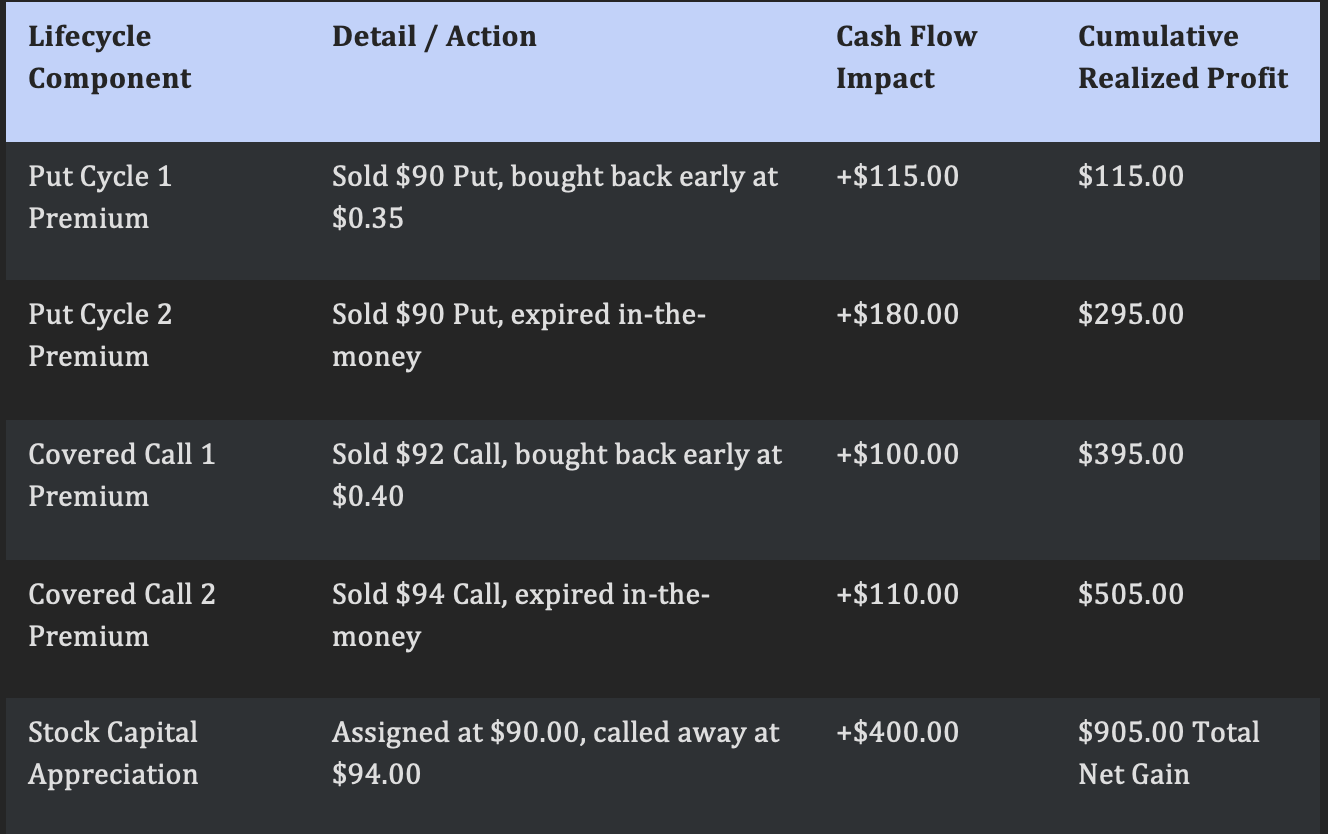
To fully understand how these concepts interact, track this chronological 90-day lifecycle of a trade using the master framework rules.
Day 1: Watchlist & Put Entry. The investor builds an income watchlist. Stock XYZ is identified as a premium target. The stock trades at $95, matching the 200MA. Implied volatility is elevated due to general market anxiety. The investor initiates the Wheel.
Action: Sells a 30-day, 15-delta Cash-Secured Put at the $90 strike price.
Premium Collected: $1.50 per share ($150 total credit).
Initial Effective Cost Basis: $90.00 - $1.50 = $88.50.
Day 12: Profit Taking & Capital Recycling. Stock XYZ rallies to $98. The option value decays rapidly due to the combination of directional upside and theta passage.
Action: The $90 put is now worth only $0.35. The investor applies the 50%-75% Profit Rule and buys back the put for $0.35.
Net Premium Secured: $1.15 per share ($115 total profit).
Day 13: Re-Entry. The market experiences a broad sector pullback. Stock XYZ drops back to $94. The investor scans the board for structural entries.
Action: Sells a fresh 45-day Cash-Secured Put at the $90 strike price.
Premium Collected: $1.80 per share ($180 credit).
Day 40: Share Assignment & True ECB Accounting. A sudden macroeconomic data release triggers a severe market sell-off. Stock XYZ gaps down violently, breaking technical support and closing at $87. The short put is now deep in-the-money.
Action: The option expires. The investor is assigned 100 shares at the $90 strike price. The broker locks up $9,000 in cash collateral to acquire the stock inventory.
True ECB: $90.00 (Assignment Strike) - $1.15 (Cycle 1 Profit) - $1.80 (Cycle 2 Credit) = $87.05.
Day 41: Covered Call Entry. The stock shows signs of stabilization at $88. The investor moves to the call side of the Wheel. Chart analysis indicates heavy resistance at $92.
Action: Sells a 30-day Covered Call at the $92 strike price (sitting safely above the true ECB of $87.05).
Premium Collected: $1.40 per share ($140 credit).
New Adjusted ECB: $87.05 - $1.40 = $85.65.
Day 63: Secondary Profit Management. Stock XYZ drifts sideways between $89 and $90. Time decay dissolves the call premium.
Action: The $92 call premium drops to $0.40 (a 71% reduction in option value). The investor buys back the contract to secure the profit.
Net Premium Secured: $1.00 per share ($100 profit).
Day 64: Call Redeployment. The company prepares for an upcoming dividend. The investor scans technical charts. Resistance has now climbed to $94.
Action: Sells a fresh 30-day Covered Call at the $94 strike price.
Premium Collected: $1.10 per share ($110 credit).
New Adjusted ECB: $85.65 - $1.10 = $84.55.
Day 90: Expiration & Position Conclusion. Stock XYZ experiences a strong institutional accumulation wave, breaking through resistance and closing at $96. The short call is breached.
Action: The covered call contract expires. The shares are called away at the $94 strike price.
Final Cash Realized: The investor receives $9,400 cash for the share inventory.
The Scorecard: Capital exposed was $8,455 (Final ECB x 100). Capital returned is $9,400.
Net Strategic Profit: $9,400 - $8,455 = $905 total cash profit over 90 days on a stock that net moved only $1.00 (from $95 to $96).
Audit Checklist: Lifecycle Capital Flows
Part 6: Risk Management, Common Mistakes, and Case Studies
Portfolio Position Sizing and Capital Allocation Guidelines
To prevent a single structural market downturn from breaking your account infrastructure, implement clear institutional capital allocation limits:
Maximum Position Limits: No individual underlying asset should account for more than 10% to 15% of your total liquid portfolio capital. This protects the portfolio if an unforeseen event creates a massive downward gap. No single assignment should materially alter your portfolio construction.
Sector Capping: Limit overall exposure to any single industry sector (e.g., Technology, Financials, Energy) to 30% of total wheeling capital. Correlated sector assets drop together during industry specific rotations.
The Cash Buffer Rule: Always maintain a minimum 15% to 20% liquid cash or high-yielding cash-equivalent buffer across your account. This cash must remain entirely un-pledged. It serves as your defensive baseline, allowing you to execute tactical rolls for credits and comfortably navigate unexpected assignment spikes without triggering a margin crisis.
Advanced Efficiency Variations
Once you master the traditional Wheel, you can introduce advanced variations to optimize your capital allocation. These setups should be limited to your designated Income or Trading buckets.
Variation 1: The LEAPS Wheel (Poor Man’s Covered Call). Acquiring 100 shares of an expensive, high-quality stock requires massive capital. To bypass this, replace the stock infrastructure with a deep ITM LEAPS call option (typically expiring 1 to 2 years out with a 0.80+ delta).
The Advantage: A LEAPS option mirrors the price action of 100 shares but costs 40% to 60% less capital. You can sell short-term covered calls against this LEAPS contract, dramatically expanding your percentage return on capital.
The Risk: LEAPS have an expiration date and do not collect dividends. This variation requires active management and is not suitable for beginners.
Variation 2: The Hybrid Wheel. To solve the problem of losing your favorite long-term stocks during sudden market rallies, implement layered ownership. If you own 300 shares of a core asset, designate 100 shares as an un-capped core holding and utilize the remaining 200 shares for active covered call wheeling. This structural split guarantees you participate in massive upside moves while still harvesting consistent income from the broader position.
Variation 3: The Cashless Wheel. Traditional put selling requires keeping 100% of your strike value in idle, low-yield cash. Advanced traders utilize portfolio margin or high-yield collateral to back their short puts. This allows your underlying capital to remain productive elsewhere while you collect option premiums. Position sizing must remain highly conservative here; leverage can easily amplify losses during sharp market corrections.
The 10 Costliest Wheel Mistakes
Chasing Premium: Selecting high-volatility, low-quality tickers just for a large options payout.
Wheeling Junk: Selling puts on a stock you would hate to own during a 30% market drawdown.
Aggressive Call Strikes: Selling covered calls too close to the current share price and cutting off your own upside.
Chasing Breakouts: Selling calls at the exact moment a stock breaks out of a long consolidation period.
Blindsided by Earnings: Forcing short option positions through unpredictable corporate earnings cycles.
Emotional Rolling: Rolling positions for a net debit simply to delay an inevitable assignment.
Squeezing Expiration: Holding short contracts until Friday afternoon to capture the last few pennies instead of taking profits early.
Obsessing Over Win Rate: Damaging your long-term ECB reduction because you fear assignment or avoid taking a small, logical loss.
Lazy Bookkeeping: Failing to calculate your true ECB metric across your entire portfolio.
Forgetting the Business: Treating your underlying assets like tickers on a screen rather than analyzing corporate fundamentals.
The Wheel Investor’s Pre-Trade Checklist
Before Selling a Put:
Would I happily own this stock at this price point for the next 5 years?
Does the strike sit at or below verified technical support, moving averages, or dark pool prints?
Is IV elevated enough to justify taking on the buying obligation?
Have I confirmed that no major earnings catalysts or binary events occur during this contract cycle?
Before Selling a Covered Call:
Would I gladly and without regret sell my shares at this strike price tomorrow morning?
Does this strike clear major technical resistance and prior structural highs?
Am I preserving enough asset upside to justify the premium amount collected?
If an ex-dividend date is approaching, does the remaining extrinsic value exceed the dividend payment?
Conclusion: The ECB Investor Mindset
The complete evolution of a trader occurs when they stop tracking daily price changes and start tracking risk reduction. The stock market is designed to trigger emotional decisions through continuous noise, volatile charts, and daily fluctuations. By shifting your primary performance score from raw share price to ECB, you decouple your emotions from short-term market anxiety.
Successful execution of the Wheel Strategy demands that you prioritize the underlying asset first and the option premium second. High premium is an explicit warning sign of underlying structural instability, not an open invitation to collect easy cash. True wealth is generated by accumulating positions in high-quality businesses that you confidently wish to own across multi-year horizons. The option chain serves strictly as an operational mechanism to buy those companies at structural discounts and sell them at logical valuation ceilings.
Under this framework, assignment is welcomed as a natural inventory transition. Acquiring shares at a pre-planned, discounted entry point is a strategic victory, while allowing an option to expire worthless is an identical success. Both outcomes systematically drive down your total capital at risk. When you eliminate the emotional fear of holding physical inventory, strike selection becomes rational, rolling operations become objective, and patience transforms into a compounding financial asset.
The mathematics of the ECB snowball are unstoppable when applied to durable companies. Every option premium captured, dividend collected, and rolling credit secured is a direct extraction of capital out of the market and back into your account. Over extended cycles, this continuous capital return constructs an insulated defensive buffer that buy-and-hold investors can never match. Even during prolonged sideways trends or severe macro corrections, your position actively improves its resilience simply because you are harvesting time decay.
Ultimately, consistency beats market prediction. Professional portfolio management is not about guessing the direction of next week’s candlestick; it is about managing capital efficiency and maintaining iron discipline. The elite wheel trader does not seek market entertainment, constant validation from high win rates, or volatile premium windfalls. They choose to sit on their hands during low-volatility regimes, systematically bypass binary risk traps and strike selectively when fear inflates option pricing.
As you deploy this playbook, protect these structural guardrails with absolute rigidity. Compartmentalize your core assets, manage your position sizing caps, protect your cash buffers, and take your profits early. Maintain your logbooks diligently. Let other market participants exhaust themselves chasing immediate home runs. Your scorecard is clear, your system is repeatable, and your process is locked. Lower your cost basis, insulate your capital, and let time decay do the heavy lifting.